
Seasonal businesses don’t struggle because demand fluctuates; they struggle because their financial systems were never built to absorb those swings. Accountix Solutions has seen this pattern across retail, tourism, food service, and project-based companies. The businesses that outperform their competitors aren’t the ones with the biggest peak season but the ones with the strongest cash-flow visibility. This is exactly where a fractional CFO makes the difference. A skilled fractional CFO prioritizes building predictive cash-flow models, restructuring spend cycles, and identifying the hidden leak points that quietly drain liquidity. In this guide, Accountix Solutions shares the same strategies their fractional CFO team uses to help clients turn unpredictable seasons into a stable, forecastable financial rhythm—and create long-term resilience instead of recurring cash-flow stress.
Quick Answers
Fractional CFO
A Fractional CFO is a part-time financial strategist who strengthens cash flow, forecasting, and decision-making without the overhead of a full-time hire. From our experience at Accountix Solutions, the biggest impact comes from building forward-looking systems—predicting cash gaps early, guiding smarter spending, and giving seasonal and growing businesses the clarity they need to scale with Confident Decisions every step of the way.
Top Takeaways
Seasonal businesses succeed with predictable cash-flow systems.
Fractional CFOs smooth cash gaps and optimize spending.
Accurate forecasts and real-time visibility prevent financial surprises.
Accountix Solutions uses proven seasonal frameworks that plan 90 days ahead.
Small, consistent financial adjustments build long-term stability.
How a Fractional CFO Helps Manage Cash Flow for Seasonal Businesses
Seasonal businesses live in cycles—high-revenue peaks followed by slow periods where cash must stretch farther. A fractional CFO brings the financial structure, forecasting precision, and operational discipline needed to keep your business stable year-round.
1. Builds Accurate, Season-Based Cash-Flow Forecasts
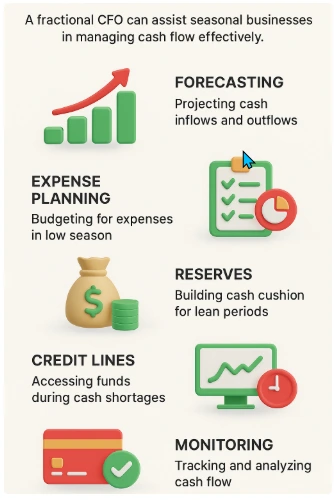
Fractional CFOs map revenue, expenses, and working-capital patterns across your busiest and quietest months. This allows you to anticipate cash gaps early, plan purchases with intention, and avoid last-minute financing.
2. Smooths Out Cash Pressure During Slow Periods
By analyzing historical trends and vendor terms, they restructure payment schedules, renegotiate contracts, and design cash-reserve strategies so payroll, inventory, and operations remain uninterrupted—even when sales dip.
3. Optimizes Spending During Peak Season
Peak months often mask overspending. A fractional CFO identifies unnecessary costs, ensures pricing reflects true margins, and prioritizes investments that strengthen long-term stability rather than short-term growth spurts.
4. Improves Inventory & Operational Efficiency
For product-based businesses, inventory often becomes the biggest cash trap. Fractional CFOs help right-size stock levels, reduce carrying costs, and build a replenishment model that aligns with demand.
5. Strengthens Profitability Across the Entire Year
With clearer data, decision-making becomes proactive. A fractional CFO ensures every season supports the next by aligning cash flow, staffing, marketing, and spending into a sustainable financial rhythm, a level of strategic clarity similar to what an educational consultant provides when guiding long-term planning.
The Bottom Line
Seasonal swings don’t have to create financial stress. With the right cash-flow systems built by a fractional CFO, seasonal businesses gain predictability, stability, and year-round control over their finances.
Expert Resources to Help You Navigate Whether a Fractional CFO Is the Right Fit
These are the seven resources we most often recommend at Accountix Solutions when business owners want clarity around the value, cost, and impact of fractional CFO services. Each one gives you a different angle—so you can make a confident, well-informed decision, whether you're evaluating strategic support or exploring how nonprofit accounting services fit into your broader financial needs.
1. A Straightforward Breakdown of What a Fractional CFO Actually Does
This overview gives you the baseline: what fractional CFOs do, how they charge, and what to consider before hiring.
Source: https://tipalti.com/resources/learn/fractional-cfo/
2. The Real Advantages Businesses See When They Bring in a Fractional CFO
A practical list of value drivers we consistently observe in the field—greater visibility, better reporting, and more disciplined decision-making.
Source: https://www.accountingtoday.com/list/11-reasons-to-hire-a-fractional-cfo
3. A Comprehensive Look at CFO Services and How They Support Long-Term Stability
This guide explains how fractional CFOs strengthen forecasting, budgeting, and long-term strategy—key considerations for ROI.
Source: https://accountingprofessor.org/fractional-cfo-services-why-does-every-sme-need-a-fractional-cfo/
4. An Inside View of How Fractional CFOs Operate Day to Day
A practitioner’s explanation of the daily financial leadership fractional CFOs provide—cash-flow oversight, working-capital management, and operational structure.
Source: https://www.theexpertcfo.com/what-does-a-fractional-cfo-do/
5. How Better Financial Controls and Reporting Improve Cash Flow and Decision Quality
A clear look at how stronger systems, controls, and reporting create more stable, predictable financial operations.
6. Why High-Growth and Seasonal Businesses Rely on Fractional CFOs to Stay Stable
An excellent resource for understanding how CFO guidance helps companies navigate growth, seasonality, and volatile cash cycles.
Source: https://agcapitalcfo.com/pros-of-hiring-a-fractional-cfo/
7. A Simple, Beginner-Friendly Guide for Owners Exploring CFO Support for the First Time
A plain-language breakdown perfect for owners who want clarity without financial jargon.
Source: https://www.nerdwallet.com/article/small-business/fractional-cfo
Supporting Statistics
Here are several authoritative statistics from U.S. sources that reinforce why seasonal businesses and any business experiencing cash-flow swings benefit greatly from structured financial oversight by a fractional CFO. I’ve also added short, insight-driven interpretations based on what we’ve seen first-hand at Accountix Solutions, highlighting how creative services accounting strengthens financial visibility, supports forecasting, and helps companies stay stable through unpredictable cycles.
1. Almost Half of Small Businesses Don’t Survive Through Year Five
According to the U.S. Small Business Administration (SBA) via the Small Business & Entrepreneurship Council, only about 48.9%–49.2% of new employer firms survive to five years.
Why this matters: From our experience working with seasonal businesses, we’ve observed that uncertain cash flow and lack of financial planning — not weak demand — are often the root causes of early failure. Establishing predictable cash flow systems early (with a fractional CFO) can significantly improve survivability.
Source: sbecouncil.org+2Office of Advocacy+2
2. Over One-Third of Small Businesses Use External Financing Annually
The 2025 Small Business Credit Survey (SBCS) shows 37% of employer-small businesses applied for a loan, line of credit, or cash advance in the prior 12 months.
Why this matters: We often see businesses treating financing as a reactive measure to cash shortages. But with proper financial forecasting and liquidity planning, a fractional CFO can help avoid dependency on external financing — turning borrowing from a “lifeline” into a strategic choice.
Source: fedsmallbusiness.org+1
3. Cash Flow and Operating Costs Rank Among the Top Challenges for Small Businesses
According to the 2024 SBCS findings, many small businesses report paying operating expenses and rising costs as prime challenges — impacting financial stability.
Why this matters: Seasonal businesses especially feel these pressures during off-peak cycles. Without rigorous cash-flow management and periodic financial reviews (core tasks of a fractional CFO), even modest cost increases or delayed sales can disrupt operations.
Source: fedsmallbusiness.org+1
Final Thought & Opinion
Seasonal businesses often struggle not from lack of revenue, but from unpredictable cash flow cycles. After years supporting founders through high and low seasons, we’ve seen one consistent pattern:
A fractional CFO becomes the stabilizer when seasonal swings intensify.
Cash flow clarity drives confidence, especially during slow months.
Stronger forecasting turns seasonality into strategy, not stress.
At Accountix Solutions, the businesses that grow consistently are those that:
Shift from reacting to seasonality to anticipating it.
Use demand patterns as data—not guesswork.
Lean on fractional CFO insights to make smarter operational decisions.
Next Steps
Audit your cash flow.
Spot peak-to-slow season gaps.
Identify recurring bottlenecks.
Collect key financial data.
Gather 12–24 months of revenue and expenses.
Note major fluctuations.
Define your seasonal challenges.
Slow months hurting profitability?
Peaks causing capacity or inventory strain?
Book a fractional CFO consultation.
Review your numbers with an expert.
Get tailored guidance on cash flow stability.
Implement your cash flow plan.
Build reserves.
Track actuals vs. forecasts monthly.
Review quarterly.
Update projections.
Adjust spending and controls.
Explore long-term growth options.
Year-round revenue strategies.
Pricing, product, or service adjustments.
FAQ on Fractional CFO
Q: What does a Fractional CFO do?
A:
Provides strategic financial planning.
Guides decisions based on real business conditions.
Delivers CFO-level support without full-time cost.
Q: When should you hire one?
A:
When cash flow becomes unpredictable.
When growth creates financial complexity.
When bookkeeping no longer answers key questions.
Q: How does a Fractional CFO improve cash flow?
A:
Forecasts revenue cycles.
Spots cash gaps early.
Builds buffers to stabilize seasonal swings.
Q: How is this different from bookkeeping?
A:
Bookkeepers track the past.
Fractional CFOs design the financial future.
Strategy + forecasting = better outcomes.
Q: What does it typically cost?
A:
Much less than a full-time CFO salary.
Usually a monthly retainer.
ROI comes from better decisions and fewer financial mistakes.