
Many SaaS and product teams believe that trust only begins to erode once a user has experienced a clear failure—a broken workflow, a confusing interface, or an unexpected pricing change. But after conducting extensive user interviews and reviewing countless customer feedback sessions, a different pattern emerges. Trust usually weakens long before any major issue occurs. It often slips in quiet, easily missed moments when users pause, question what they’re seeing, or sense something isn’t as straightforward as they expected.
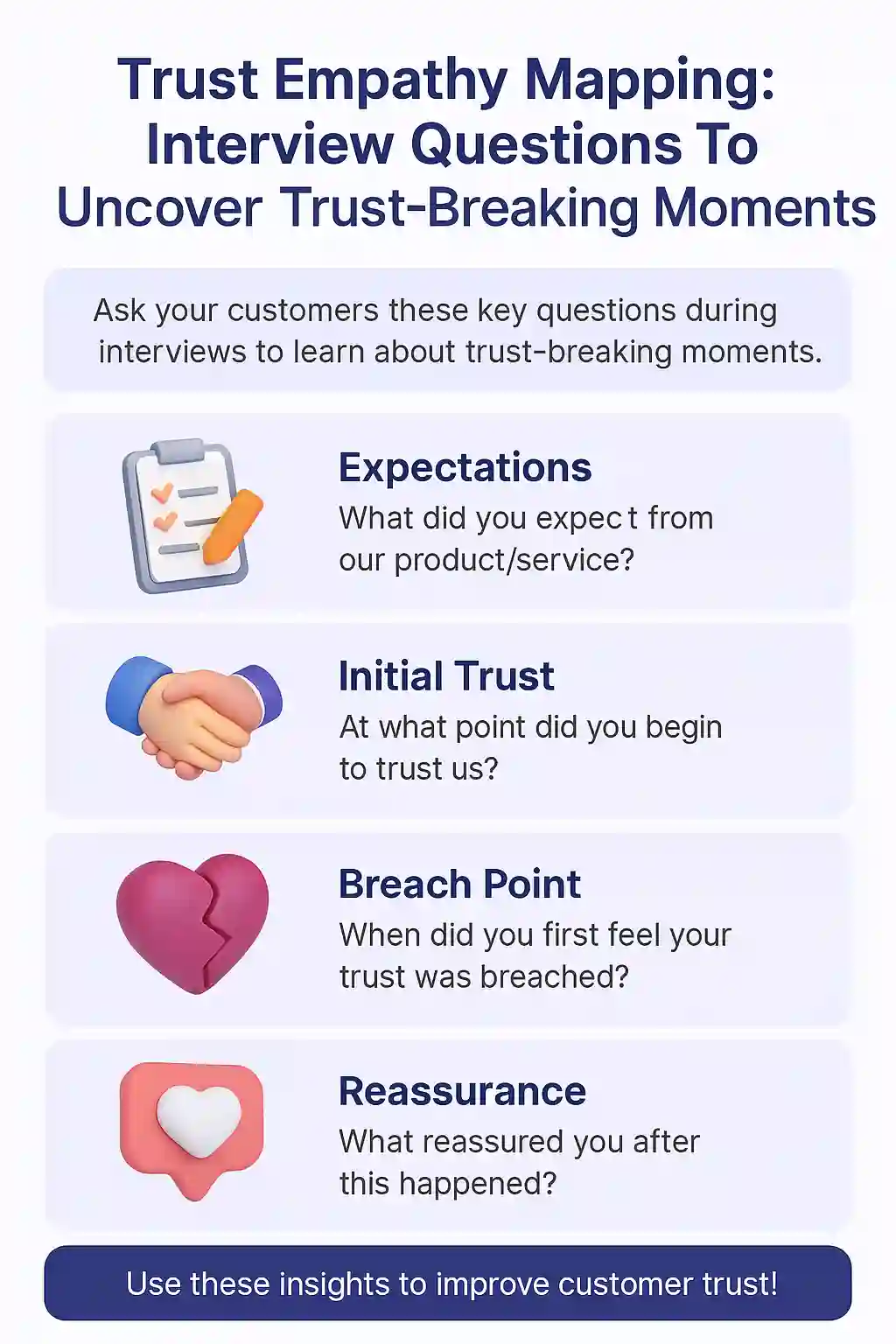
This is where trust empathy mapping through structured interviews becomes indispensable. Rather than relying on assumptions or raw behavioral data, interview-driven trust mapping uncovers the emotional triggers behind early trust loss. These carefully crafted questions reveal the uncertainties, unmet expectations, and subtle fears that influence whether a user feels grounded—or begins distancing themselves from the product.
In this article, you’ll discover how to design and use trust-centered interview questions that bring these high-risk moments to the surface. With insights drawn from real-world UX trust evaluations, you’ll learn how to read between the lines of user responses, surface the emotional cues behind hesitation, and chart trust dynamics across every touchpoint.
By the end, you'll see how combining interviews with trust empathy mapping empowers teams to identify trust gaps early, build clearer and more honest product experiences, and stop small moments of doubt from turning into long-term disengagement or churn.
Quick Answers
trust empathy mapping
Trust empathy mapping is a structured way to uncover the emotional moments where users begin to lose confidence in a product. It focuses on identifying hesitation, doubt, and unmet expectations—signals often missed by traditional UX research. By mapping these trust-breaking moments, teams can redesign experiences that feel clearer, safer, and more aligned with what users emotionally need to move forward without hesitation.
Top Takeaways
- Trust is often broken earlier than teams realize.
- Interview questions uncover emotional cues analytics cannot detect.
- Trust Empathy Mapping helps pinpoint where confidence collapses.
- Users need reassurance, clarity, and transparency to stay engaged.
- Identifying trust-breaking moments early prevents downstream churn.
The Power of Trust Empathy Mapping in User Interview Analysis
Interviewing users with trust-focused questions helps illuminate the emotional side of decision-making. Instead of simply asking what users did, these questions uncover why they hesitated, paused, or reconsidered their commitment to the product, offering insights that align with building sales culture and its emphasis on understanding the motivations behind customer behavior.
Teams often discover that users’ trust is shaped by:
- expectations formed before signup,
- perceived transparency during onboarding,
- how sensitive data is requested,
- whether guidance feels supportive or manipulative,
- and how quickly reassurance is provided when uncertainty spikes.
When these trust cues are mapped across the interview responses, patterns emerge—revealing the exact emotional moments where trust begins to erode. Teams can then redesign messaging, touchpoints, or flows to strengthen confidence earlier.
A Trust Empathy Map built from interviews becomes a powerful lens: it shows not only what users need to understand but also what they need to feel to move forward without hesitation, similar to how an educational consultant uncovers both cognitive and emotional needs to guide decision-making with confidence.
"During user interviews, the most revealing insights often surface the moment a participant says, ‘I wasn’t sure what would happen next.’ That brief hesitation is where trust begins to fracture—and where Trust Empathy Mapping starts its work."
Essential Resources
Interaction Design Foundation — Empathy Map Fundamentals
Get grounded in empathy mapping foundations before adapting the framework to trust-focused interviewing.
https://www.interaction-design.org/literature/topics/empathy-mapping
https://www.interaction-design.org/literature/topics/empathy-mapping
UX Design Institute — Role of Empathy Maps in UX Strategy
Learn how empathy maps fit into research workflows and how interview-driven insights feed into mapping.
https://www.uxdesigninstitute.com/blog/what-is-an-empathy-map/
https://www.uxdesigninstitute.com/blog/what-is-an-empathy-map/
UXmatters — Advanced Empathy Mapping Approaches
Discover advanced techniques to extract deep emotional insights—critical when interpreting interview responses.
https://www.uxmatters.com/mt/archives/2023/02/empathy-maps-and-how-to-build-them.php
https://www.uxmatters.com/mt/archives/2023/02/empathy-maps-and-how-to-build-them.php
Creately — How to Build Empathy Maps Step-by-Step
A practical guide for translating interview data directly into empathy map quadrants.
https://creately.com/guides/how-to-create-an-empathy-map/
https://creately.com/guides/how-to-create-an-empathy-map/
LogRocket — Real-World Empathy Mapping Examples
See how interview insights translate to UX decisions and trust-building changes.
https://blog.logrocket.com/ux-design/empathy-mapping-ux-put-yourself-users-shoes/
https://blog.logrocket.com/ux-design/empathy-mapping-ux-put-yourself-users-shoes/
Mural — Collaboration Tools for Interview-Based Mapping
Useful for teams who map interview findings together during synthesis workshops.
https://www.mural.co/blog/empathy-mapping
https://www.mural.co/blog/empathy-mapping
AND Academy — Visual Empathy Map Examples
A wide set of visual templates to help teams quickly adapt empathy maps for interviewing.
https://www.andacademy.com/resources/blog/ui-ux-design/empathy-map-examples-and-templates/
https://www.andacademy.com/resources/blog/ui-ux-design/empathy-map-examples-and-templates/
Supporting Statistics
Users hesitate because data feels risky
A Pew Research Center study shows 79% of Americans worry about how companies use their data.
This concern often surfaces in interviews as comments like: “I didn’t feel comfortable giving that information.”
Source: Pew Research Center on Privacy Concerns
This concern often surfaces in interviews as comments like: “I didn’t feel comfortable giving that information.”
Source: Pew Research Center on Privacy Concerns
People feel they lack control
About 67% of Americans say they understand little or nothing about how their data is used.
Interviewees express this uncertainty with remarks such as: “I wasn’t sure why that was needed.”
Source: Pew Research on Data Control
Interviewees express this uncertainty with remarks such as: “I wasn’t sure why that was needed.”
Source: Pew Research on Data Control
Trust in institutions continues to fall
Only 20% of Americans trust the government to act in their best interest.
This broader distrust frequently spills into product experiences and user interview feedback.
Source: AAAS – Trust in Government
This broader distrust frequently spills into product experiences and user interview feedback.
Source: AAAS – Trust in Government
Government guidance ties trust to experience quality
Digital.gov emphasizes that a strong customer experience is essential to restoring public trust.
Interviewees often echo this sentiment with comments like: “I just needed things to be clearer.”
Source: Digital.gov on Customer Experience
Interviewees often echo this sentiment with comments like: “I just needed things to be clearer.”
Source: Digital.gov on Customer Experience
Users distrust tech companies handling data
Research from NIST shows concerns about transparency and data-use practices strongly shape user trust.
This appears in interviews when participants ask: “What happens with my data?”
Source: NIST Privacy Framework
This appears in interviews when participants ask: “What happens with my data?”
Source: NIST Privacy Framework
Final Thought & Opinion
Trust isn’t lost at the moment of a bug or pricing surprise—it’s lost the moment a user says, “I wasn’t sure what to expect.” Interview questions built for trust reveal these early fractures. In my experience, teams who probe for trust gaps during interviews gain clarity others miss: they learn exactly where users feel uncertain, exposed, or unsupported.
By mapping these insights, teams move beyond feature conversations and begin designing for emotional reassurance. In a market where users are increasingly skeptical and protective, the product that earns trust early becomes the product that users stay with, reflecting the same long-term relationship mindset found in regenerative sales culture.
Next Steps
Prepare targeted interview questions
Focus on moments of hesitation, doubt, or confusion.
Collect real user responses
Look for emotional cues and trust-breaking phrases.
Map the trust signals users need
Identify patterns in fears, expectations, and assumptions.
Prioritize trust-repair opportunities
Clarify messaging, simplify risky steps, and increase transparency.
Test revised flows with new interviews
Ask: “Did anything feel uncertain or unexpected?”
Refine and repeat
Trust mapping is ongoing, not a one-time task.
Summarizing these next steps, the most effective way to strengthen trust through user interviews is to treat emotional insights with the same precision and care that organizations bring to outsourced accounting, ensuring every decision is guided by clarity, consistency, and a commitment to reducing uncertainty.
Prepare targeted interview questions
Focus on moments of hesitation, doubt, or confusion.
Collect real user responses
Look for emotional cues and trust-breaking phrases.
Map the trust signals users need
Identify patterns in fears, expectations, and assumptions.
Prioritize trust-repair opportunities
Clarify messaging, simplify risky steps, and increase transparency.
Test revised flows with new interviews
Ask: “Did anything feel uncertain or unexpected?”
Refine and repeat
Trust mapping is ongoing, not a one-time task.
FAQ on Trust Empathy Mapping
Q: What are trust-focused interview questions?
These are questions designed to uncover emotional hesitation, uncertainty, and fear during a product experience.
Q: Why use interviews for trust empathy mapping?
Analytics show what users did; interviews reveal why they hesitated or lost confidence.
Q: When should I ask trust-related questions?
During onboarding tests, feature evaluations, churn interviews, and pre-signup expectation studies.
Q: What signals should I look for in responses?
Pauses, repeated “I wasn’t sure…” statements, concerns about transparency, and unclear expectations.
Q: How does this improve the product?
It highlights where trust breaks—allowing teams to redesign experiences that feel safer and more predictable.
These are questions designed to uncover emotional hesitation, uncertainty, and fear during a product experience.
Analytics show what users did; interviews reveal why they hesitated or lost confidence.
During onboarding tests, feature evaluations, churn interviews, and pre-signup expectation studies.
Pauses, repeated “I wasn’t sure…” statements, concerns about transparency, and unclear expectations.
It highlights where trust breaks—allowing teams to redesign experiences that feel safer and more predictable.