
The first thing to go missing after a house manager resigns is rarely the keys. It's everything they knew: the boiler vendor at the lake house, the week the umbrella policy renews, the principal's rule about getting a call before any charge over a set amount. Most Family Office Concierge functions run on that one person's memory. When they resign, take leave or hand the work to an outside provider, much of it walks out with them.
A concierge started out as the keeper of a building's keys. Inside a family office, the job has grown into ongoing lifestyle management, covering bill pay, residences, vendors and travel along with the hundred small details that keep a household running. A task handover checklist lets that work change hands without missed payments or lapsed renewals.
We've coordinated enough household transitions to see the pattern. The families who got through them calmly wrote the work down long before anyone gave notice. Here's how to build that record in eight steps.
TL;DR Quick Answers
Family Office Concierge
Family Office Concierge is ongoing lifestyle management run with family office discipline. It takes on the labor of living, from bill pay to residences and vendors, under defined approvals and documentation so the household never depends on one person's memory.
What it covers: household bill pay with defined approvals, oversight of multiple residences, vendor coordination, and logistics for travel and major projects
How it differs from a personal concierge: it's ongoing and tied into the family's financial administration rather than a run of one-off errands
Who it works with: existing household staff and vendors stay in place while the concierge team coordinates them
Why continuity matters: documented workflows keep staff changes, extended leave and seasonal moves from disrupting the household
Who it suits best: families with several homes, a high volume of invoices and vendors, and a strong preference for privacy and discretion
Top Takeaways
Write the checklist before anyone resigns. One drafted during a notice period is always missing something.
Go through the last 90 days of invoices and calendar entries with the outgoing coordinator to find commitments nobody wrote down.
Confirm approval tiers, dual authorization and payee verification before a new person touches bill pay.
Move credentials through a secure vault, rotate codes and cut off the outgoing person's access on their last day.
Close with an overlap period, a formal sign-off and a review 30 days later.
Why a Family Office Concierge Handover Breaks Without a Checklist
A disciplined Family Office Concierge model swaps individual memory for documented approvals and a standard anyone on the team can follow. Without that structure, continuity depends on whoever happens to be in the seat, and the household's records end up scattered across inboxes, invoices and text threads.
Most handovers happen at one of five moments:
A concierge, house manager or executive assistant leaves the role
Extended leave or vacation requires temporary coverage
The family moves concierge work to an outsourced family office executive services
A seasonal move shifts operations to a secondary residence
A generational transition hands decisions to a new principal
The bills keep coming even after the person who tracked them has gone. A renewal notice sits unopened. A vendor waits on an approval nobody knows they're supposed to give. And a gate code stays active for someone who no longer works for the family.
A checklist turns each of those risks into a named task with an owner. It also gives the principal something that's usually missing during a staff change, which is a clear view of what's moving, to whom and when. Multi family office services help maintain this visibility by keeping responsibilities, transitions, and follow-through organised under one coordinated process.
How to Create a Family Office Concierge Task Handover Checklist in 8 Steps
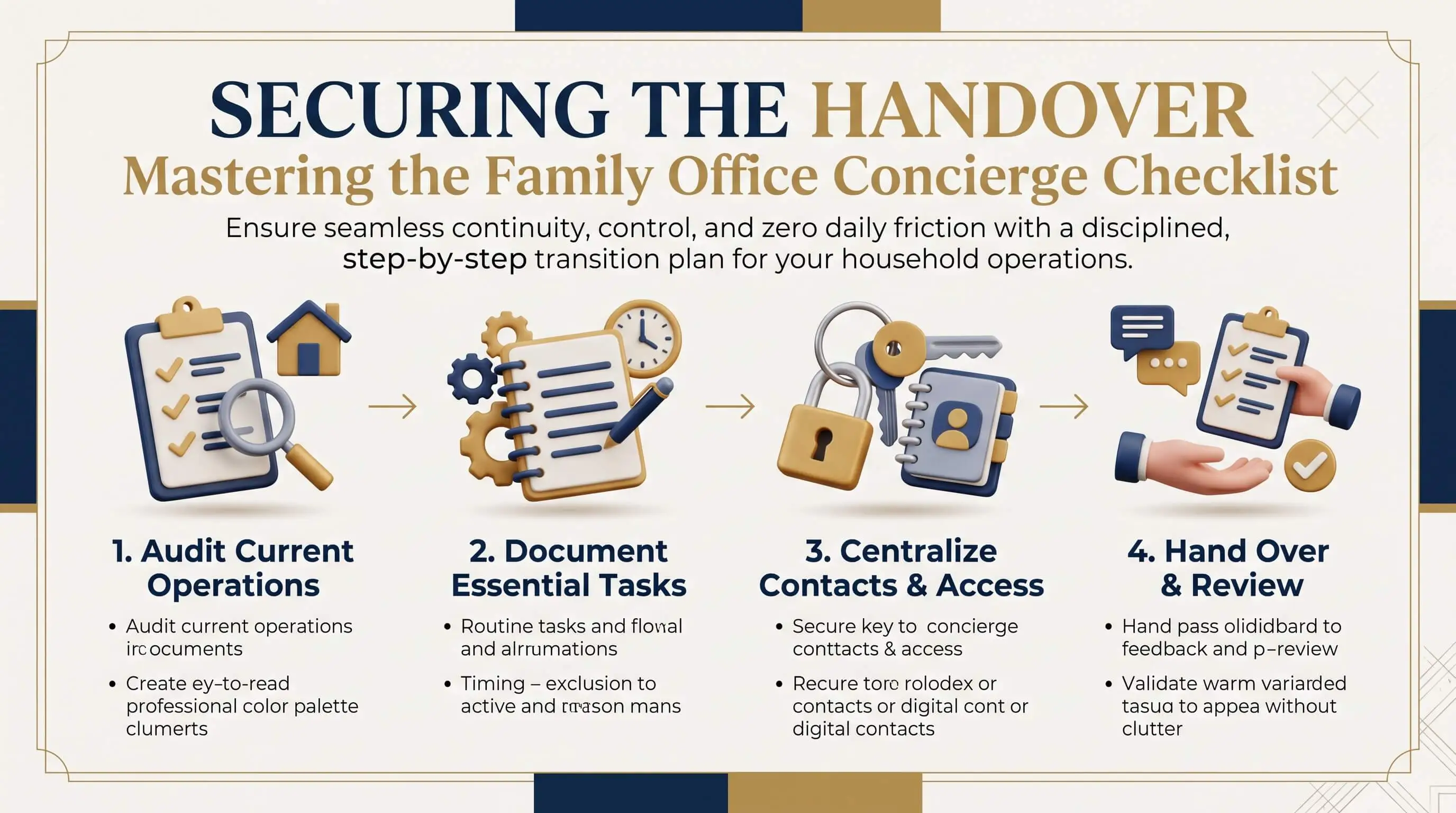
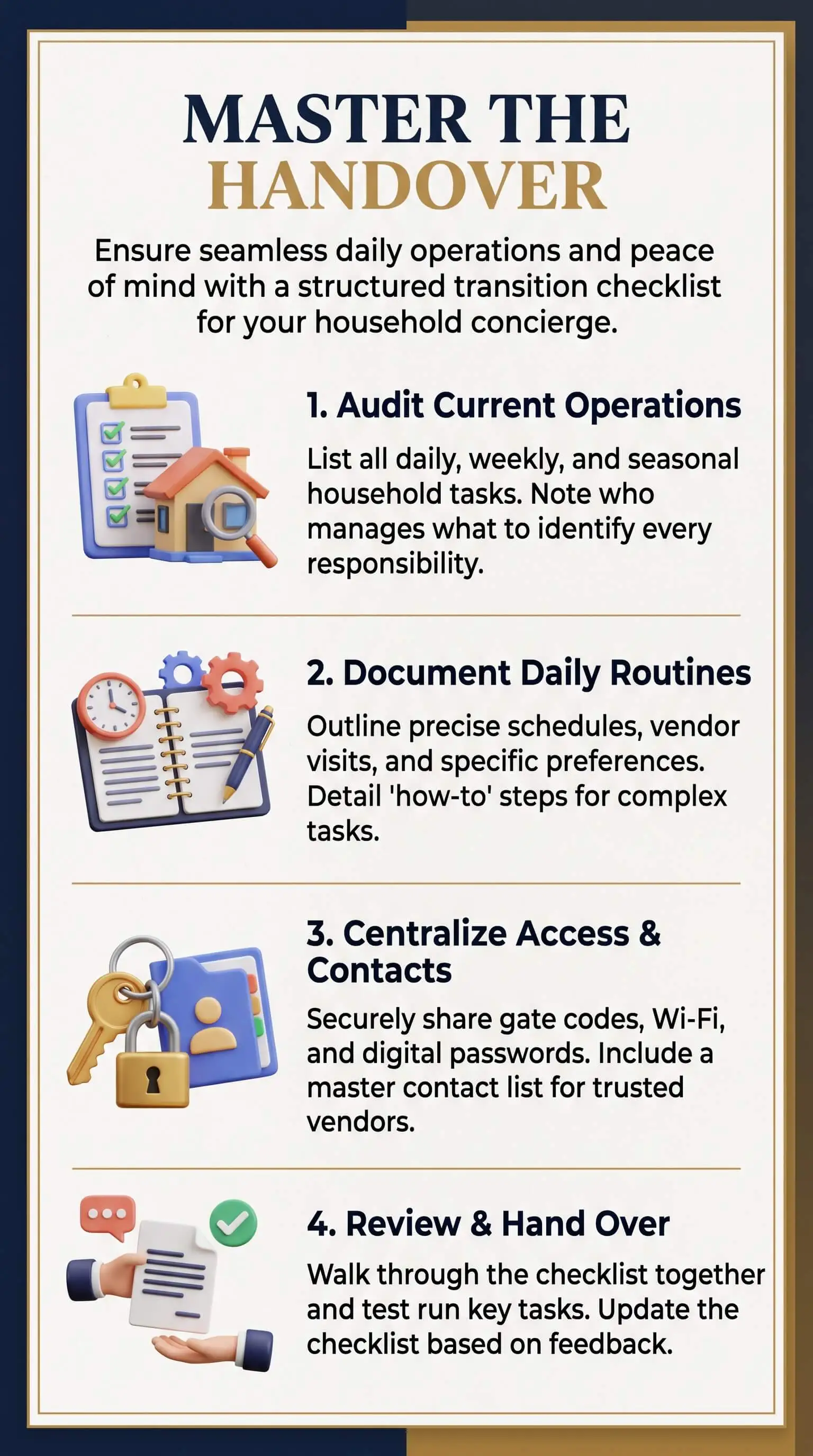
Build the checklist in eight moves. Inventory recurring tasks, record preferences and privacy rules, compile the vendor directory, transfer financial controls, secure access, hand over residences and assets, map the family calendar, then finish with a shadow period and formal sign-off.
Step 1: Inventory Every Recurring and In-Flight Task
Start with the full list, because a task without an owner is the one that slips. Record what each task is, how often it recurs, when it's next due and where it stands today. Don't skip the once-a-year items like property taxes, club dues and insurance renewals. Those are the ones people forget. Assign anything due in the next 30 days to the incoming owner before the outgoing person leaves. One habit we rely on is sitting down with the outgoing coordinator to walk through the last 90 days of invoices and calendar entries. Unwritten commitments tend to surface fast.
Step 2: Document Principal Preferences and Privacy Rules
Service quality lives in preferences, and almost nobody writes them down. Capture household profiles, travel and dining preferences, how each family member likes to be contacted and who's allowed to make requests on the family's behalf. Then spell out the privacy rules. Vendors need to know what they may see, and staff need to know which financial and personal information never leaves the office. Those rules protect the family on the day an unfamiliar person starts handling sensitive requests.
Step 3: Build the Vendor and Household Staff Directory
List every vendor and staff member with their role, contact details, contract terms, service levels and renewal dates. Note how invoices arrive, who each vendor answers to and any performance concerns. Then make the introductions by phone or in person. In our experience, a vendor who's met the incoming coordinator calls when something breaks, while one who hasn't often just waits. Keep the directory in one central place, never on someone's personal phone.
Step 4: Transfer Financial Controls and Approval Tiers
Bill pay is where a rushed handover does the most damage. Build a calendar of every recurring obligation, then write down the approval tiers that govern each payment: spending limits, who signs off on what and which payments need two people. Before money moves to a new payee or a changed bank account, the controller or approver should confirm it by calling a known contact. Carry the documentation standards over too, so every payment stays traceable after the transition. Outsourced accounting can support this process by maintaining accurate records and consistent payment controls throughout the handover.
Step 5: Secure Access, Credentials and Keys
Passwords never travel by email or text. Move credentials through a password manager or secure vault, and once the handover is done, rotate alarm codes, gate codes and shared logins. Keep a log of every physical key, fob and access card and who holds it. On the outgoing person's last day, revoke their access everywhere, including portals, smart-home systems and any vendor accounts set up in their name.
Step 6: Hand Over Residences, Assets and Seasonal Protocols
For each residence, record the maintenance schedule, key vendors, security contacts and the opening and closing protocols for seasonal use. Add luxury assets as well, such as vehicles, boats and collections, with their storage, servicing and insurance details. Seasonal continuity is where we see the most gaps. Whoever closed the summer house last September may be the only person who knows the shutoff sequence.
Step 7: Map the Education and Family Calendar
Families with school-age children keep a second calendar that rarely shows up in household records. Capture tuition and fee due dates, term dates and boarding travel, school transport and the health and emergency forms each school requires. If the family works with an educational consultant during school transitions, add that consultant to the directory, since school decisions often drive travel, housing and staffing changes. [Internal link: host article on educational consultants and school selection; confirm URL before publishing.]
Step 8: Run a Shadow Period and Formal Sign-Off
Plan for two to four weeks of overlap whenever you can. The incoming person handles live requests while the outgoing person watches and corrects. Confirm escalation rules, including who gets the call in an emergency and who can approve exceptions. Then the principal or chief of staff signs off formally, and a review 30 days later catches whatever the checklist missed.
Family Office Concierge Handover Checklist at a Glance
Task inventory: Recurring and in-flight tasks, frequencies, due dates and status. Owner: outgoing coordinator. Sign-off: chief of staff.
Preferences and privacy: Household profiles, standing preferences, request permissions and confidentiality rules. Owner: outgoing coordinator. Sign-off: principal.
Vendors and staff: Contacts, contracts, service levels, renewal dates and introductions. Owner: outgoing and incoming coordinators. Sign-off: chief of staff.
Financial controls: Bill pay calendar, approval tiers, dual authorization and documentation standards. Owner: personal CFO or controller. Sign-off: principal.
Access and security: Password vault transfer, code rotation, key log and access revocation. Owner: incoming coordinator. Sign-off: chief of staff.
Residences and assets: Maintenance schedules, seasonal protocols, insurance and asset servicing. Owner: incoming coordinator. Sign-off: chief of staff.
Education and family calendar: Tuition dates, term travel, transport and school forms. Owner: incoming coordinator. Sign-off: principal.
Shadow period and review: Overlap plan, escalation rules and 30-day review date. Owner: chief of staff. Sign-off: principal.
"Handovers rarely fail because people didn't try hard enough. They failed because the household was running on one person's memory. When we step into a transition, the first thing we do is sit down with the outgoing coordinator and go through the last ninety days of invoices, calendar entries and vendor messages, line by line. That review almost always turns up commitments nobody wrote down. Our position is simple. Continuity shouldn't depend on who's in the seat. It should rest on a system the family can see and approve."
7 Essential Resources
FundCount: Family Office Concierge Services, What They Include and How to Run Them Well. A working operating model for concierge requests, from intake and approvals through closure. Its vendor onboarding checklist is worth borrowing as is.
Select Advisors Institute: Personal Concierge for Family Offices. Covers governance, approval tiers and service levels, plus handover protocols for bringing the next generation into the service.
Hawksford: Deepening Client Relationships Through Concierge Services. A private client director explains why concierge now sits next to fiduciary work, with continuity and discretion at its center.
Altss Glossary: Concierge Services. A short definition, along with a note on which roles, usually the chief of staff or estate manager, own concierge in practice.
EY: How Family Offices Can Broaden Their Risk Mindset. Describes "process by trust," the habit of leaning on long-serving staff instead of documented processes, and why it raises key-person risk.
Citi Wealth 2025 Global Family Office Report. Shows where family offices still lag on professionalization, including operational risk management and leadership succession.
RBC and Campden Wealth: North America Family Office Report 2026. The latest figures on operational and cybersecurity risk, including the payment controls families depend on.
3 Statistics
54% of family offices name key-person turnover as their top internal threat. In a Dentons survey reported by Institutional Investor in 2024, only 44% said they had hired additional staff or improved information sharing and training to reduce that risk. What this means for your handover: the risk is widely recognized, but the documentation that answers it is often missing.
Dual payment authorization fell from 84% to 72%. According to RBC and Campden Wealth's North America Family Office Report 2026, adoption of this basic control slipped even as 56% of respondents named cybersecurity and data breaches their biggest near-term operational risk. What this means for your handover: confirm approval tiers and payee verification before anyone new touches bill pay.
92% of family offices say nonfamily professionals stay five years or longer. Wharton Global Family Alliance benchmarking data, analyzed by EY, found that 52% employ seven or fewer professionals. What this means for your handover: long tenure in small teams concentrates knowledge in a few people, so a single departure can expose years of undocumented process.
Final Thoughts
A handover shows you whether a household runs on systems or on memory. If the checklist comes together in an afternoon, the documentation and approvals were already there. If it drags on for weeks, that difficulty is the finding. One person's diligence has been holding things together, and the family has carried more risk than it realized.
We'd go further. Don't wait for a resignation to learn which kind of household you have. Run the checklist every year, even when nobody's leaving, and use it to drop vendors who no longer earn their place, update approval tiers as spending changes and shut off access that's quietly piled up. A Family Office Concierge function that could be handed over tomorrow is one that's working well today.
The labor of living doesn't pause for a staff change, and with a well-kept checklist, it doesn't have to.
Frequently Asked Questions
What is a Family Office Concierge handover checklist?
A Family Office Concierge handover checklist is a structured document that moves household and lifestyle responsibilities from one person or provider to another. A good one covers recurring tasks, preferences, vendors, financial controls, access, residences and the family calendar, and gives every area a named owner and a sign-off.
When should a family office run a concierge handover?
Run one any time responsibility changes hands, whether that's a resignation, extended leave, a move to an outsourced provider, a seasonal shift between residences or a generational transition. Many families also run it once a year with no change planned, simply to keep their records current.
How long should a concierge task handover take?
Most households need two to four weeks of overlap, then a review 30 days later. Families with several residences, a long vendor list or heavy seasonal activity may need more time. The incoming owner should handle live requests under supervision before taking over completely.
Who should sign off on a concierge handover?
Final sign-off belongs to the principal or the family's chief of staff, while the personal CFO or controller should confirm the financial controls. Record the sign-off with the date, the areas approved and any open items that carry into the 30-day review.
How do you transfer passwords and access securely?
Use a password manager or secure vault, never email or text. Afterward, rotate alarm and gate codes, change shared logins and revoke the outgoing person's access to portals, smart-home systems and vendor accounts. Keep a log of every physical key and access card as well.
How do school logistics fit into a concierge handover?
School logistics run on their own calendar. Include tuition and fee due dates, term and boarding travel, transport arrangements and the health and emergency forms each school requires, along with contact details for any educational consultant the family works with during school transitions.
Keep Your Household Steady Through Every Transition
A staff change shouldn't put your payments or your privacy at risk. Legacy Bridge Private Family Offices provides Family Office Concierge support built on defined approvals and clear documentation, with consistent follow-through behind every request. Continuity rests on a system, not on any one person. Whether your family is preparing for a transition or simply wants the labor of living handled with discretion, our family office services provide the coordination and oversight you need. Schedule a private consultation with the Legacy Bridge team.